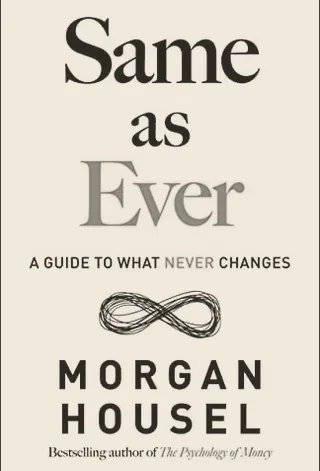
Morgan Housel + Eric Jorgensen are two of my favourite authors - they write so cleanly. Everything is succinct, to the point, and valuable.
This book is about one concept - most people ask “what will change in the world in the next 10yrs?”. This is very difficult and only a few people in history have been able to do this. Instead, we should ask “what won’t change in the world in the next 10yrs?”. Answering this question, we can then overinvest in things we know will not change.
Jeff Bezos asked himself this question - for Amazon, they knew customers will always want low prices and quick shipping, so he made enormous bets here.
Each chapter in this book talks about a different element of the world that has, and will, stay the same as ever. Each bullet point below is a different element:
- Predicting what the world will look like 50 years from now is impossible - but predicting people will respond to greed, fear, opportunity, exploitation, risk, uncertainty, tribal affiliations, social persuasion in the same way is a good bet.
- Risk is what you don’t see coming, so invest in preparedness, not in prediction.
- “The world isn’t driven by greed, it’s driven by envy.” People base their happiness on outcome vs expectations.
Wealth/happiness is what you have + what you expect/need. We can control the 2nd part. You think you want more, but actually you want a gap between what you expected + what happened.
- People capable of achieving great things often take risks that can backfire just as powerfully. “History reveals no instances of a conqueror being surfeited by conquests.” aka an insatiable appetite.
- People don’t want accuracy, they want certainty.
- People’s difficulty with probability makes us overly sensitive to run of the mill inevitable risks
- Best story wins - we live in a world where people are bored, impatient + need complicated things distilled into easy to grasp scenes.
- Some things aren’t measurable - the real world is a never ending chain of absurdity, confusion, messy relationships, imperfect people
- Stability is destabilising - if things are good, people will keep pushing for more until that thing breaks (eg Federer). Only very few see the power of enough (eg Khabib).
- Growth is not a strategy, it is a tactic - there’s a convenient size for most things - push past this and you’ll experience pain.
Greatest impediment to creativity is impatience, the almost inevitable desire to hurry up the process. Have the patience to let something grow, and scarcity to admire what it grows into.
- Fear breeds extreme innovation (army created planes, cars, nuclear, radar, internet)
- Good news comes from compounding, bad news happens quickly
- Balance optimism with pessimism - be able to survive short term problems so you can stick around long enough to enjoy long term growth.
- Little changes compounded for a long time create extraordinary changes
- Don’t try to be perfect - the more precise you try to be, the less time you have to focus on big picture rules that are probably more important
- It’s supposed to be hard - that’s part of it - there’s an optimal level of hassle to accept, even embrace
- Competitive advantages are short lived
- 1/ overconfidence. size = success = hubris = beginning of the end
- 2/ success means growth, but a large org is different to a small one, and some strategies won’t work at same scale
- 3/ with success the paranoia becomes less, allowing competitors
- 4/ valuable skills in one org may not extend to the next
- 5/ some success is being in the right place at the right time
- the wonders of the future are incredibly hard to predict - as they are 10-20yrs of incremental compounding work. Typical path of new innovations:
- i’ve never heard of it
- i’ve heard of it, but i don’t understand it
- I understand it, but i don’t see how it’s useful
- I see how it could be fun for rich people, but not me
- I use it, but it’s just a toy
- It’s becoming more useful for me
- I use it all the time
- I could not imagine life without it
- Seriously, people lived without it?
- It’s too powerful and needs to be regulated.
- Most things are harder than they look and not as fun as they seem - everyone is dealing with problems they don’t advertise, at least until you get to know them well.
- Incentives are the most powerful force in the world and can get people to justify or defend almost anything
- Unexpected hardship makes people do + think things they’ve never imagine when things are calm
- It’s hard to imagine the full context until you experience it first hand.
- We are attracted to complexity - gives an illusion of control, while simplicity is hard to distinguish from cluelessness. Signals thoughtfulness.
- People who’ve had different experiences than you will think differently than you do. Experiences will always be different, disagreement will be constant.