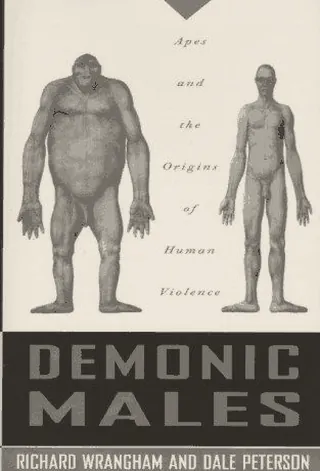
- Core thesis: male violence is evolutionary Male violence (war, murder, rape) is not just cultural—it has deep evolutionary roots Humans share ~99% DNA with chimpanzees → behavioural parallels matter Aggression historically increased reproductive success (status, territory, mates) Violence is framed as an adaptive strategy, not a moral anomaly
- Chimps as the model for human violence Male chimps form coalitions and conduct lethal raids on rival groups Violence is strategic: expand territory → access to food + females Within-group hierarchy enforced through intimidation and aggression Strong parallels to human warfare, gangs, and political violence
- Types of male violence (patterns)
Intergroup violence: coordinated attacks, “proto-warfare”
Intragroup dominance: hierarchy, bullying, coercion
Sexual coercion: forced mating strategies (seen across apes)
Infanticide: males kill offspring to bring females back into fertility
These are presented as recurring evolutionary patterns, not random acts
- Human societies: continuity, not exception Early human groups (incl. hunter-gatherers) show frequent warfare Patriarchal structures are widespread across civilizations Male coalitions (armies, tribes, gangs) mirror chimp alliances Technology amplifies violence, but underlying drives are ancient
- The “peaceful ape” contrast (bonobos) Bonobos = close relatives but dramatically less violent Key differences: Strong female alliances dominate males Sexual behaviour diffuses tension Less male coalition aggression Shows violence is conditional on social/ecological structure, not inevitable
- Drivers of male aggression Competition for mates (sexual selection) Coalitionary power (groups of males outperform individuals) Resource control (territory, food) Power asymmetry encourages aggression (attack when low risk)
- Biology vs culture Biology provides propensity, not destiny Brain systems (e.g. emotion + rational control) shape decisions Culture can suppress or amplify aggression Institutions (laws, states, norms) reduce violence over time
- Implications for modern society Violence won’t disappear by moral arguments alone Reducing inequality and power imbalances lowers aggression Increasing female political/social power may reduce conflict Strong institutions are key to controlling innate tendencies
- Big takeaway Humans are not uniquely violent-but we are uniquely capable of scaling violence Our psychology is shaped by evolutionary pressures shared with apes The future depends on managing, not denying, these instincts
←The bookcase
One of the books Shaun rated five out of five.